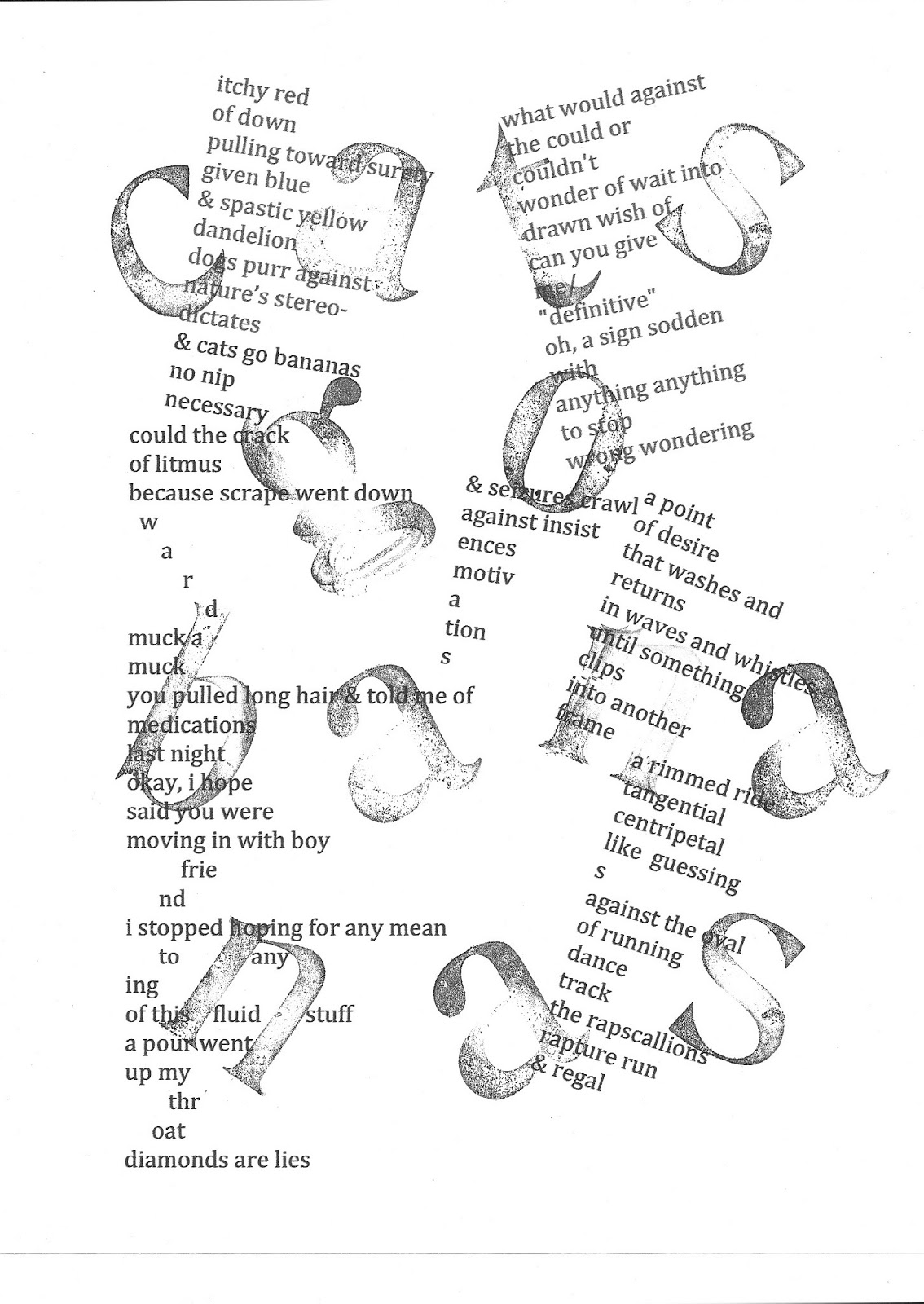
by Dan Gutstein & Buck Downs
 |
| "Dan (L) and Buck (R) disassociated and rokken, ca. unknown" |
DAN: So I’ve been going back and forth with Jeff & he’s
like, I’m spozed to axe you about the Corin Tucker (I know not these) poems but
after that, he wants you to axe me some questions, too. So, I’d axe you a
question, then you’d answer all Buck Downs and then you’d axe me a question, if
that makes sense.
BUCK: That shouldn’t have to count as your first question—we
think a lot about what counts, huh? the riddle of where jump ends and rock
begins, stuff like that—but Jeff refers to “I Wanna Be Your Corin Tucker”, a
series of poems from a few years back. Parts of it appeared in Altered Scale last year, is why he asked, & you can look them up there.
The title plays on a Sleater-Kinney song, “I Wanna Be Your
Joey Ramone”, and so there’s a pantheon renovation or upgrade project
referenced there. 90s rock stays on my mind at least as much as “classic punk”,
odd phrase to type. The poems more or less happen there, taking place in some
Black Cat of the Mind.
So I met you after you moved here, I guess? ten years ago,
more? then you moved away for a while, and then you came back, & you’ve
been here for a while, but moved around within DC, and now make the commute up
Baltimore for work. I was at your place to hear Cathy Wagner & Susana
Gardner read a few months ago, and it seems to me that you’ve had to make a lot
of “no” decisions when it comes to keeping stuff. So different to me—I’ve been
living in the same house for almost 20 years, and the house is just piles of
stuff. So what about moving, getting rid of stuff? Do you miss any stuff? What
does that mean?
DAN: Ah, I just read the Corin Tucker poems at Altered Scale 2 and I dig. They seemed a
little bit different in tone for you—praps cuz I’m used to hearing your voice
thunder through a reading space, I’m used to getting personal problem postcards
in the mail, I’m used to your Florida armadillo-kickin’ persona, and I really
enjoyed them. We kinda go “I Just Wanna Be Your Dog” to Joey Ramone to Corin
Tucker just like that!
It’s true, but I do live very minimally, and it’s a
thoughtful observation for you to make. I don’t have much furniture, just about
the only luxury I allow myself is a huge bookshelf of jazz CDs, and I only keep
about 100 or 150 books around. Part of that has to do with the ‘temporary’
feelings that I’ve always had as a writer, who constantly has to worry about
where his next dollar may be coming from, but my Baltimore job has been very
stable over the past few years, and so I’m like, humph, why no clutter? It is
good, as with the Cathy/Susana reading, to have some central space, and I enjoy
hosting parties, as well. I’ve held a few legendary shindigs over the years,
including the one (in my Kalorama Rd apt.) where Rod poked his head in through
the hatch and in asking Tom for a match, somehow, psychically collapsed the
chair from underneath Mr. Orange. But I digress. Yes, I think you and I have
known each other for 15 years, at least. I used to work for you over on New
York Ave!
Part of our shenanigans as friends, has involved the Gus
Burger. We’ve both eaten one, and we both know the record for eating Gus
Burgers—3 Gus Burgers in 8 minutes. Do you think you could beat that? How much
mayonnaise have you seen in the hands of a dude who just sprang out of the
floor? I think what I’m getting at is—you’re a writer who (among his many
gifts) can synthesize the oddities and humor and human behavior, etc., around
us, and make it ‘everyday accessible’, thoroughly unique, and at that,
revitalizing to the spirit. At least for me it is. What are you after, as a
writer? What drives you to say what you say? What are the internal guide-posts
that meter or free your language?
BUCK: The Gus Burger from the White Spot in Charlottesville,
Va., involves a lot of mayo and a fried egg. It seems conceptually suspect, but
is tasty enough to make anyone (well, at least you & I) think that eating
three of them in 8 minutes would be pretty easy. FWIW, you can get something
similar at Mr. Henry’s, on Capitol Hill; they call it a “hangover burger” and
features egg, cheddar, and bacon. Kind of a two-fer, in case you missed
breakfast.
What is the deal, that I am after? I have been a person who
has intrusive thinking, racing mind, conversations that don’t take place
between people who will never meet, and some other related stuff going on more
or less all the time. It’s quite a show, up in here. If I don’t write it down,
it gets pretty tiring. So that’s what the source material is—the end result of
trying to cope with a semi-continuous crypto-discourse that’s going on in and
around me.
That stuff fills up notebooks, and when the notebooks get
filled, they get typed up, making something like a 150pp. answer to the
question, “dude what *were* you thinking?” Reading back through, cutting and
pasting, rewriting: I get to set what I am thinking today alongside what I was
thinking two years ago; a kind of parallax view.
And so, two questions for you: up until a few years ago, the
highly varied kinds and numbers of jobs you’ve done seemed to be a significant
source of material or ground from which your writing grew. Now you’ve had the
same job for quite a while, and actually have kind of homed in on the specific
kind of writing/teaching job you do at MICA. What does it mean for you, not to
be doing a variety of jobs for the time being, and what does it mean for the
writing you get to do?
And second, are you the editor who added “Gus Burger” to the
Urban Dictionary?
DAN: The Squirrel, our after-readings haunt, offers the
possibility of an egg atop a burger—as a “fixin’” but not as a formal sandwich
with a name. I mean, I think about that guy, Gus, who must’ve been so well
known for his eggburger fondness that the White Spot bemonikered its eggburger,
or, you know, it could be that generic Get off the Bus, Gus, kinda thing, so it
may be an Everywhere Gus sitch, but I doubt it. Lo, I am not the editor who
placed Gus Burger up at Urban Dictionary. I’m responsible for a few other
things there, but, alas, not the Gus Burger dernit.
There is Buck Downs the writer, and I’m grateful for those
insights into your writerly machinations, but there is, to be sure, Buck Downs
the reader-aloud. Anyone who has been to a Buck Downs reading, will remember
it. You holler, you sing, you cool it off, you speak the words. I kid you a
little bit, by calling you The Champ, but actually, I mean it, you have
impressed audiences for quite some time, and there aren’t too many poets who
soar like that—who also bring content to the table. Did this style just erupt
or did it evolve? Did you study any literary types or peeps from other worlds?
Also, somewhat up that alley, what is the status of the Buck
Downs Smile? It is the most disarming smile in American letters. I mean, I
think it’s doing just fine, but could you give a few examples of people,
situations, explosives, rhetorics, etc., that you have disarmed-by-smiling?
As for my work situation, yes, I’ve been commuting to
Baltimore for more than 5 years, mostly on the MARC train. It’s the second
position in a sequence that, by now, represents about eight years of full-time
employment, whereas I, like many writers from time to time, used to have (and
enjoyed) holding as many as 3 to 5 jobs at a time. It sounds chaotic, but
actually, if done properly, it would save and create time ... for writing. So,
does the one-job full-time system work, as a writer? I think so. Like any
schedule, you just got to get wise to it. It’s true that the many-jobs system
usually did produce a host of characters to study and perhaps capture in a
piece of writing, but this has been replaced by my exploits on the MARC, as
well as in the streets, gutters, alleyways, pubs, and byways of Baltimore.
BUCK: Having a good set of teeth is a blessing, so I can’t
really take much credit for that. Of course, there’s more to a smile than just
the teeth, but again, there’s not much that’s original with me. More than a
little of my life philosophy comes from or sounds like bumper stickers of the
sort they used to sell at e.g., Stuckey’s, and maybe still do; for example, “SMILE—It
Makes People Wonder What You’re Up To!”
There are a lot of models to list that I heard & who
gave me license to follow the sound of the voices in & out of my head.
There’s a cassette anthology Watershed did from the Naropa Archives, where I
heard Anne Waldman’s “Light and Shadow” and Allen Ginsberg’s “Ego Confession”,
among many others; there’s the Exact
Change Annual, which included “Imaginary Elegies” by Jack Spicer and “At Night
the States” by Alice Notley. There’s Lenny Bruce Live at Carnegie Hall, and
Rant in E-Minor by Bill Hicks.
But before and after all the models have been chased down,
there is a matter that I call something like cultivating a basic sense of
friendliness toward yourself and the work you do. What could come out of that
is as numerous as the people who are seriously working at writing and reading
their work. For me, it comes out as free changes in tone and register, from
joke to admonition to verbal hard bop, across the space of the poem. The
freedom to really let that out comes from a practice that involves reading my
own work to myself, aloud or silently, hundreds of times, as part of an
everyday writing practice, to develop a friendly and thorough familiarity with
the work as it is.
It’s something that came into its fullness in writing the
books of Pontiac Fever, which is to
say it took twenty years of writing poetry to get to a state where I was
writing poetry that I wanted to read and reread every day, and still do.
It’s good for me to remember the very long time it took,
because it’s easy for me, listening to someone read their poems to think, they
don’t seem to like their own poems much, or even know them particularly well.
The idea of a daily practice and personal development doesn’t
come naturally to me, lazy guy that I am. I kind of stumbled upon and stagger
through it here at middle age. But I think for you, it is something that, if
not innate, was picked up much earlier than it was for me, since your story has
included and still includes a regular athletic regimen. I think now and then
that you could write “Strength Training for Poets” and really change the MFA
world, by reintroducing the P.E. class, in a friendly way, to our peers who
grew up hating gym and gym class and gym rats and all that.
So tell us a little bit about your practice as an athlete,
and where it comes together or pulls away from your practice as a writer.
DAN: Man, I couldn’t agree with you more, about an author
who just “goes through the motions” during a reading. It happens more often
than not, and it’s perpetrated by “some of our most famous authors”, and the
implication seems to be that the audience must acknowledge this funereal
drudgery as unavoidable and necessary. All too common and ugh.
When you mention great comedians like Bill Hicks, and also
touch upon the jazz genre, hard bop, it brings to mind the many forays that
writers make into other art forms. I know, for instance, that you’re very
active in the DC Arts community, given your many associations with spaces like
DCAC, as well as the many bands who play at your readings. What do the terms “multi-genre”,
“collaborative activity”, and “artistic cross-pollination” very literally mean
to you and your writing?
In a bit of a related vein, why do you gravitate toward
certain writers? Who are some of your favorite dead and buried writers, and who
are some of your favorite living writers—that is, who are breaking ground in a
different way?
It’s interesting that you bring up my past athletic
travails. There are, as you suggest, positives and drawbacks, alike, to that
past. The positives are probably obvious enough. The discipline of training
establishes a certain regularity, and so, it was never hard to sit down for
three or four mornings in a row and write out a bunch of crap. To sit there, as
tedious and painful as it may have been, and really delve. A healthy body also
makes for an active mind. I really believe that. John Coltrane, one of the most
brilliant Americans, spent too much time, by his own admission, strung out on
various substances, and admitted that he was rarely productive in those
stretches.
The down side to the “athletic past” is the kind of “locker
room conservatism” that once attached itself to me. When I began writing poems,
they were really, really dreadful. They were narrative, and confessional, and
they were wimpy. When I came back to DC in 1995, and began to meet a few people
in the DC Poetry scene—i.e., Mark, Rod, you—was when I really began to see a
host of different possibilities. Whereas the physical nature of a sport and its
attendant ‘worldview’ influenced me on some level to craft predictable
narrative works, the avant/experimental crowd really threw me into a new
mindset. For which I’ve been very grateful.
BUCK: The topic of favorites brings me back to the idea of
cultivating a basic sense of friendliness towards yourself and the writing you
do. It sounds pretentious, I’m sure, to say “I Am My Favorite Poet”, but at the
same time, if I didn’t like what I was doing, I hope I would either change or
quit, and in fact, I have.
Here in DC we have this great little scene that continues to
remain happily and substantially sub-rosa. It has been good to me, and has
waxed and waned for some 40 years, before I got here, even. I am specifically
thinking of the poetries that came about under the moniker Mass Transit, which
is a great example of a self-supporting, mutually-sustaining creative
community, and the waves of creativity have spiraled out from it since the 70s.
Mass Transit is so great to me that it is completely beside the point and
actually very nice that it is not more widely known, and has been allowed
to grow and play in the shadow of power, undisturbed by institutional care.
And I was typing the part above yesterday, and Tina Darragh
walked by the window where I was! and I completely lost the bead of what I was
thinking/typing. So yeah, mad obeisance and lifetime membership to the Mass
Transit/DCPoetry.com continuum for me.
From time to time I get into a string of correspondence with
a writer who’s not in DC, and they almost always remind me how great it is to
have landed in DC and wound up in this poetry constellation (Joe Ross, I am
thanking you today!). By comparison, it seems like it kinda sucks to be a poet
almost everywhere else in America, and I am at a loss to understand why that
would be. But then I’ve been living here for 25 years now, and my perspective
is probably challenged. What do you say, Dan—is DC the best, or what? If So,Why?
If Not, Why Not? & you can have the last word on all these things, unless
something else comes up.
DAN: I think that poetry communities will thrive for a few good reasons. The biggest one is—there must be cheap-enough quarters in town for young, interesting writers to inhabit, and in so milling-around, find a scene such as ours, hang out with us, give readings, attend readings, and slay us with their mayhem. And I think that we have a cadre of excellent young energy in our midst: folks recently enough like Ronan the Barbarian, Fitz, ‘The Voice’ Marston, the other Fitz, the second other Fitz, and Pook, and so forth. I realize that one of them Fitzzes is about my age, and I’m just goofing around.
Then, I would say, the writing has to be excellent, and
boundary pushing, and innovative, and languagey, and so avant that it’s
Cossack, and it is, it is all of those things and more.
I’ve always argued that we have enough for a ‘School’, i.e.,
an anthology that could become famous, but folks with level heads have properly
thwapped me on that front, which is probably for the best. Still, I do believe
that the Mass Transit/DC Poetry.com reservoir of writings could be condensed
into a major anthology, and so—yes, DC is among the best, and I don’t think
there is a city fulla poets who could take us, simply put. I’d like our chances
vs. Enny-City.
____________________________
Dan Gutstein and Buck Downs both appear in AlteredScale.com issue 2. (Link is to contents page.)
Blood and Gutstein, Dan's blog.
Dan Gutstein at wikipedia.
Buck Downs at Lulu.com
DCPoetry.com
____________________________
Dan Gutstein and Buck Downs both appear in AlteredScale.com issue 2. (Link is to contents page.)
Blood and Gutstein, Dan's blog.
Dan Gutstein at wikipedia.
Buck Downs at Lulu.com
DCPoetry.com